Dev console
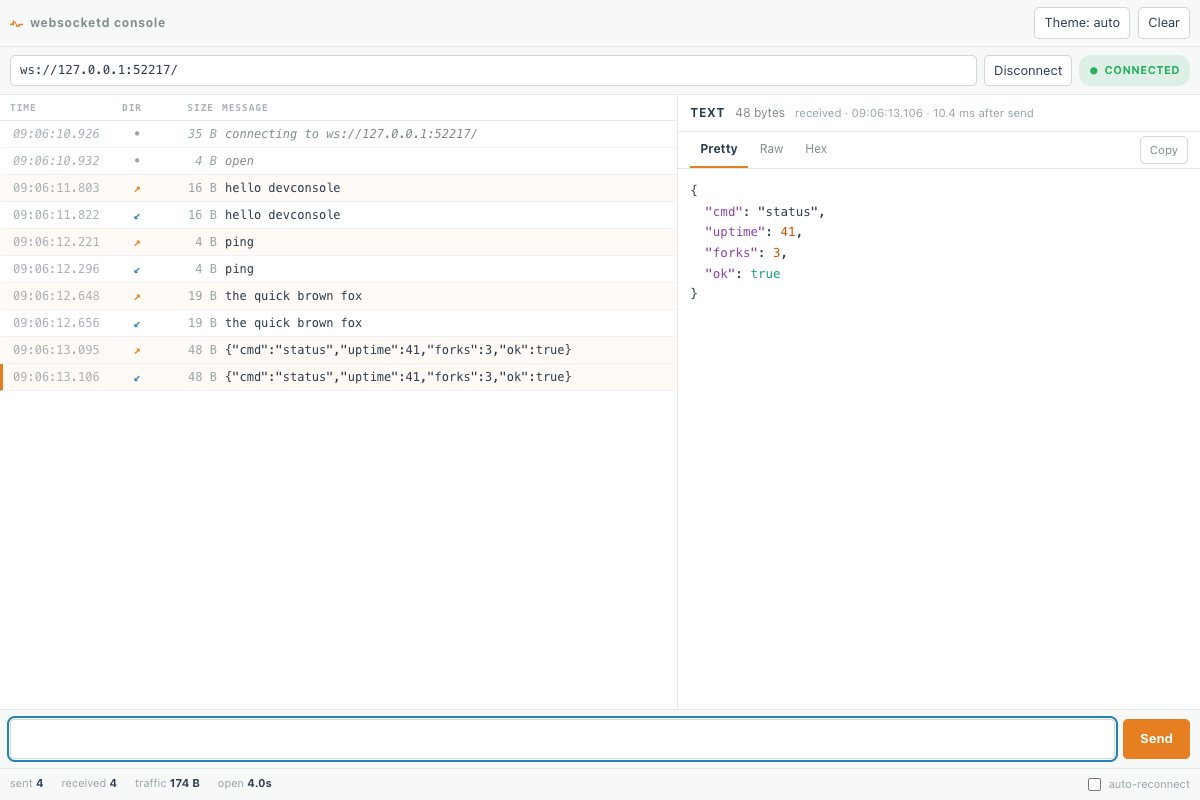
--devconsole makes websocketd answer every non-WebSocket HTTP request
with one built-in HTML page: a WebSocket client that connects to an
endpoint you type, sends messages, and shows every frame in both
directions.
websocketd --port=8080 --devconsole ./myscript.sh
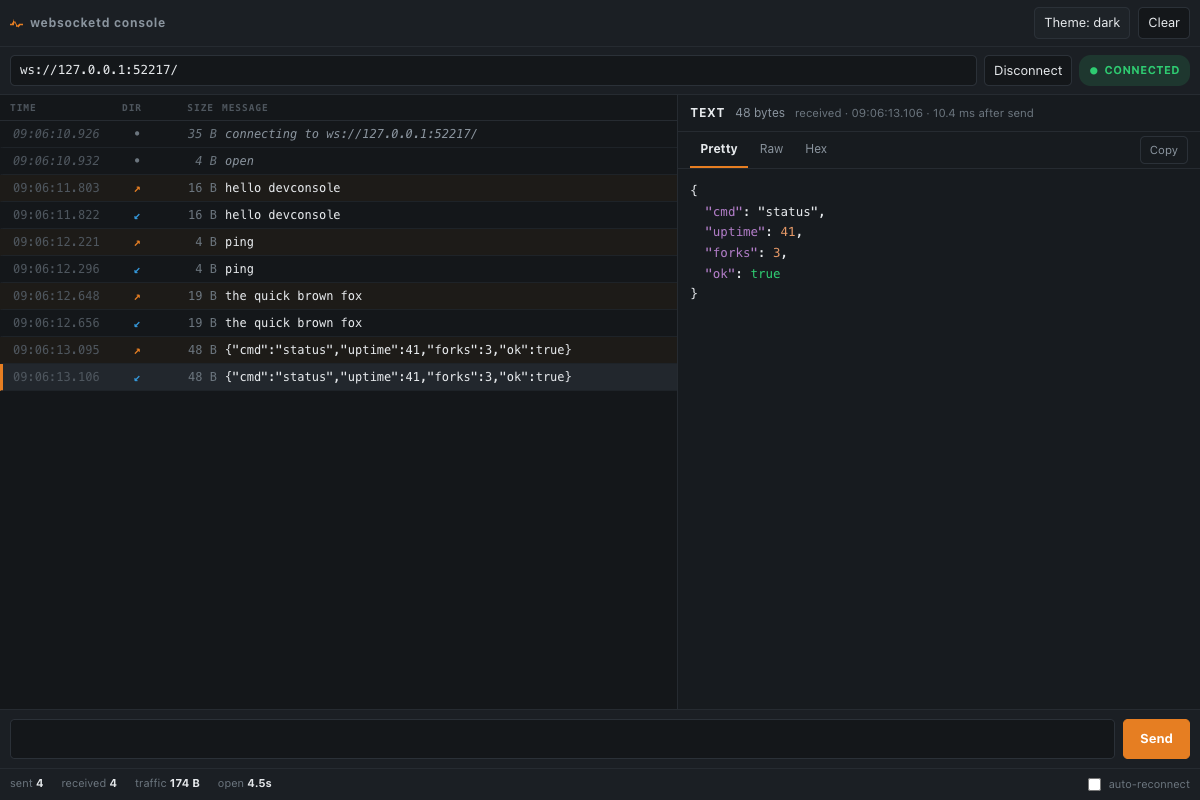
The same page in dark mode:
A short screen recording of a session is at console-demo.mp4 .
What the page contains
| Element | Behaviour |
|---|---|
| Address bar | The WebSocket URL to connect to, prefilled from the page's own location.href. Pressing Enter connects. |
| Connect button and status | Connects and disconnects; the status reads DISCONNECTED, CONNECTING, or CONNECTED. |
| Frame list | One row per frame, with timestamp, direction, size, and a preview of the message. Selecting a row opens it in the inspector. |
| Inspector | The selected frame's opcode, size, and timing, with Pretty, Raw, and Hex views and a Copy button. |
| Composer | A text area. Enter sends, Shift+Enter inserts a newline, and Up recalls what you sent before. |
| Counters | Frames sent, frames received, total traffic, and connection duration. |
| Auto-reconnect | A checkbox. When it is ticked, a closed connection is reopened one second later. |
| Theme button | Cycles auto, light, and dark. The choice is remembered in the browser. |
| Clear button | Empties the frame list. |
Nothing about the page is configurable. It is a single HTML file with its
CSS and JavaScript inline, compiled into the binary with //go:embed.
Mutual exclusions
--devconsole cannot be combined with --staticdir or with --cgidir.
All three answer the same non-WebSocket HTTP surface. websocketd exits
with code 4
if two of them are given, whichever
pair it is.
Response contract
| Property | Value |
|---|---|
| Request path | Every path. The console answers / and any other non-WebSocket request. |
| Body | A constant. No part of the request is interpolated into it; the console derives its WebSocket URL in the browser from location.href. |
Content-Type | text/html; charset=utf-8 |
X-Content-Type-Options | nosniff |
ETag | A strong validator: the first 16 bytes of the SHA-256 of the response body, hex-encoded and quoted. A conditional request carrying it is answered 304 Not Modified. |
Last-Modified | The server's startup time. |
Content-Security-Policy | See below. |
The policy is computed at process start from the page that is actually served, so the hashes cannot go stale:
default-src 'none'; script-src 'sha256-...'; style-src 'sha256-...'; connect-src ws: wss:; frame-ancestors 'none'
| Directive | Effect |
|---|---|
default-src 'none' | Nothing loads unless a directive below allows it. |
script-src | One sha256- hash per inline <script> block, over that block's exact bytes. There is no 'unsafe-inline', so a script whose bytes changed does not run. |
style-src | The same, one hash per inline <style> block. |
connect-src ws: wss: | WebSocket connections to any host, which is what the console exists to make. |
frame-ancestors 'none' | The page cannot be embedded in another page's frame. |
If the embedded page ever contained no inline <script> or no inline
<style>, websocketd panics at startup rather than serving a console
whose policy would block it.
See also
- Debug a script with the dev console drives an endpoint before you write any client code.
- CLI flags
covers
--devconsole,--staticdir, and--cgidir. - Exit codes says what code 4 means.